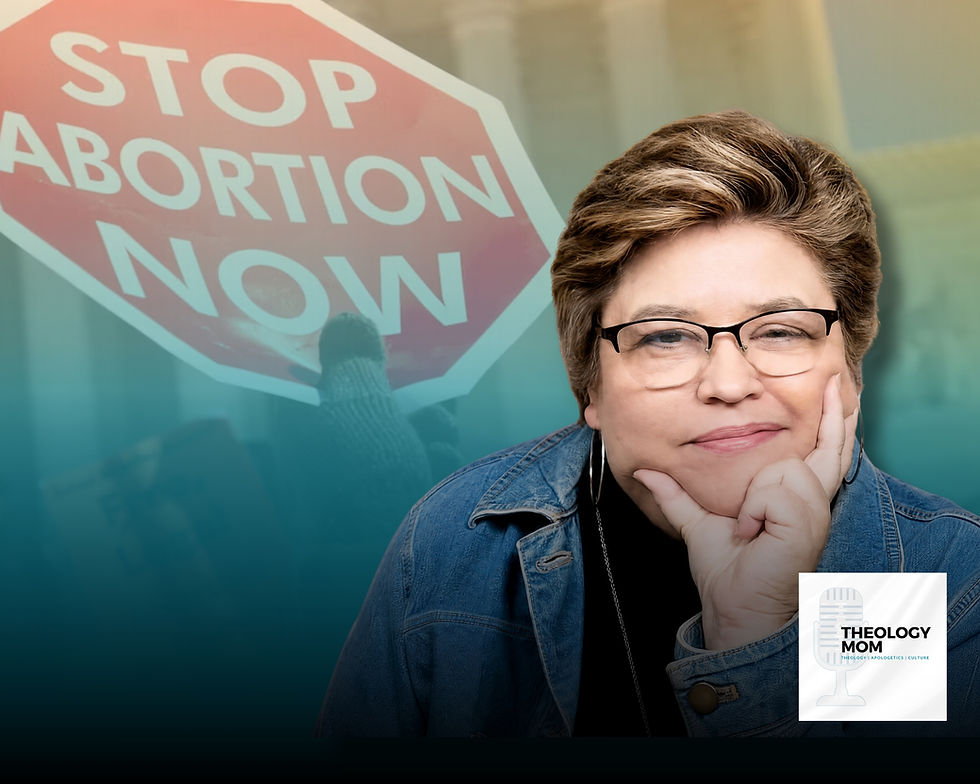
Who Are the REAL Abolitionists?

A couple of months ago I wrote an article about why I no longer call myself “pro-life.” One of my core claims was that abolitionists are changing the public conversation about how to defend the preborn. This piece is about explaining a very simple observation: it seems like the pro-life establishment is trying to keep their strategy, but steal the abolitionist language.
A ministry’s branding is one of the main ways its message reaches the public. The pro-life establishment has long leaned on slogans like “End Abortion” and “Make Abortion Unthinkable.”Abolitionists, by contrast, talk about “Equal Protection” and “Abolish Abortion.”
“Permanent” versus “Premature” Abolition
But after watching Bradley Pierce's debate with Students for Life staff apologist, JoJo Ruba a couple days ago, I think the pro-life establishment is trying a rebrand.
While the word "abolish" has appeared here and there in pro-life establishment social media posts over the years, it seems like the reframing is becoming more intentional. In his opening remarks, Ruba advocated for something he called “permanent abolition.” He labeled Pierce’s position “premature abolition.”* Here is Ruba’s complete syllogism:
The best way to pursue equal protection for the preborn is to pursue measures that will abolish abortion permanently.
To abolish abortion permanently, we must account for both cultural realities and effective enforcement challenges.
Any legislative strategy that does not account for cultural reform and effective enforcement will result in premature abolition, which will likely be reversed.
Therefore, we should pursue permanent abolition over premature abolition as the best way to provide equal protection for preborn children.
That’s a clever bit of verbal jiu-jitsu. Ruba keeps the words abolitionists made unavoidable—equal protection, abolish—and then loads them into the premises the debate is supposed to test. “Permanent” sounds like total justice. Who wouldn't be for permanent justice? In policy terms it means: do not treat abortion as homicide, keep passing partial restrictions, and wait until culture and enforcement feel safe.
Furthermore, incorporating the word “premature” into the discussion sounds like a warning about backlash. In his usage, it means any bill that actually applies existing homicide law to the preborn, including the mother as a potential defendant when she knowingly kills her child.
Now, I'm not a philosopher. I've taken a few graduate-level courses in philosophy, but really I'm just sort of an armchair philosopher. But from I where sit, it seems like Ruba's syllogism has a few underlying assumptions. It assumes that equal-protection bills cannot last. It also assumes that cultural reform must come before equal justice rather than through it. It assumes that incremental laws are the path to permanence, even after fifty years of incremental laws and a post-Dobbs landscape in which abortion rates have not diminished. Those claims are the very points in dispute. But Ruba treats them as settled premises so the conclusion against Pierce seems to follow automatically.
The framing is doing a lot of heavy lifting here. If Pierce's version of abolitionism is “premature,” then his demand for the same protection for a six-week-old in the womb that a six-week-old already has outside the womb is framed as reckless. But if Students for Life's long-game is to establish “permanent abolition," then opposing those bills, endorsing candidates who reject equal protection, and preserving maternal immunity can be sold as the prudent strategy. Pierce is cast as the leader of a doomed project, while the pro-life establishment is cast as the sober alternative.
That is a rebrand.
A Rebrand, Not a Conversion
Ruba’s aim was to make the public hear two kinds of abolitionism instead of abolition versus incrementalism. "Abolish abortion” used to be the slogan abolitionists used to distinguish themselves from the vague “end abortion" (someday) position of the pro-life establishment. “Permanent abolition” lets the old incrementalist program wear the new slogan while still treating equal protection as the threat.
This rebrand seems to be quite intentional. The home page of the Students for Life website now has the words "Abolish Abortion" in large white letters.

Now the regular people who want to protect the lives of preborn babies have to decipher, Who are the real abolitionists?
That question is not abstract.
It came up in the Pierce/Ruba debate itself. Pierce pressed Ruba about the 2022 open letter coordinated by National Right to Life and signed by more than seventy state and national groups. Kristan Hawkins, president of Students for Life of America, was one of the signers. The letter’s key line is blunt:
As national and state pro-life organizations, representing tens of millions of pro-life men, women, and children across the country, let us be clear: We state unequivocally that we do not support any measure seeking to criminalize or punish women and we stand firmly opposed to include such penalties in legislation.
That sentence is a definition, not a footnote. Equal protection means the same homicide laws that already protect born children also protect preborn children. Those laws do not create a class of killers who are legally invisible. If a mother knowingly and intentionally kills her born child, she can be a defendant. Abolitionists say the same rule has to apply before birth, or the child is not equally protected. The NRLC letter rejects that. It writes maternal immunity into the official definition of “pro-life.”
Ruba seemed to want to put some daylight between himself and that letter, however. While the organization he was representing was a prominent signer, he made it clear that he had opposed the clause, as did his mentor Scott Klusendorf. He said Students for Life hired him knowing he opposed it. When Pierce noted that Hawkins signed the letter, Ruba did not deny it. He said the letter “no longer represents our organization.” He also said he was not recanting anything. His clarification was that Students for Life now supports equal protection eventually. A destination with no date and a standing exception is still the old strategy.
Which Students for Life?
To my ears, as an outsider who doesn't move in these circles, that sounds like a rebrand under pressure.
The SFL homepage can say “Abolish Abortion.”
The staff apologist can say “permanent abolition.”
But the signed public position—the one legislators still quote when equal-protection bills appear—is that the mother must remain exempt. Ruba did not produce a retraction. Pierce pointed out that Students for Life has issued no statement repealing the letter. A later 2024 coalition letter, which Hawkins also signed, reaffirmed the same opposition when North Dakota Republicans considered a platform plank that would have treated women who abort as co-conspirators.
I'm left asking, which one is the real Students for Life? One talks like it wants to be part of some kind of abolitionist movement. The other remains bound—at least on paper—to a coalition that defines “abolition” as a world in which the abortion industry is blamed, and the principal actor in many abortions is written out of the statute. Those are two entirely different destinations.
If “permanent abolition” still requires advocating for a functionally permanent exception for the mother, then SFL is not converting to equal protection. It is attempting to rename incrementalism. Until their signature on the NRLC open letter is withdrawn in the same public way it was signed, the new slogan is branding. The old definition is policy.
Live Action’s “New North Star”
A similar pattern also shows up with Live Action, another huge cog in the pro-life establishment stream.
Lila Rose, founder and president of Live Action, has been using the word "abolish" in public for a few years. In January 2025 she posted two words in all caps: “ABOLISH ABORTION.” A year later she made the historical claim explicit: “We don’t regulate injustice. We abolish it. Slavery was abolished. Segregation was abolished. Abortion should be next.” Here is the founder of one of the largest pro-life media organizations speaking in the same rhetoric that abolitionists have used to try and separate themselves from those who want to “end abortion" (someday).
In June 2023, a coalition of twenty-six pro-life leaders, led by Live Action, published a National Review piece declaring a “New North Star” for the pro-life movement: equal protection under the Fourteenth Amendment. Kristan Hawkins was among the signers. The same week, Rep. Doug Lamborn introduced H.Res. 464, which Live Action promoted as the legislative expression of that star. Lamborn called it “the new north star for the pro-life movement.” The title sounds like the abolitionist demand: “Acknowledging that unborn children are legal and constitutional persons who are entitled to the equal protection of the laws.”
Until you read the resolve clause.
The House would acknowledge “our constitutional duty and solemn obligation to guarantee the equal protection of the laws to every unborn child… which shall not be construed to permit the prosecution of any woman for the death of her unborn child.”
That last sentence is critical. First, the resolution names the child a constitutional person. Great! But then it turns around and instructs the country not to read that personhood as permitting the mother to be a defendant when she causes the child’s death. What now? Abolitionists call that unequal protection. This resolution wants to give the appearance of equal protection, while also telling states how not to apply the law equally to all.
Here is how I see it: abolitionists have made a significant impact on the public rhetoric. Enough Christians have now been trained to want “equal protection” under the law for the preborn. So the pro-life establishment is shifting their rhetoric, while not surrendering their policy that mothers cannot be prosecuted. This is basically the NRLC letter moved onto Congressional letterhead.
To be clear, H.Res. 464 was only a resolution, not a law. But that is not the point. My very narrow point is that the pro-life establishment seems to leveraging the phrase “equal protection” now that abolitionists have made the phrase expensive to ignore. But while they adopted the language, they also kept the exception.
Words Mean Things
Again, the regular people who want to protect the lives of preborn babies are left to wonder, Who are the real abolitionists? I would say that this resolution offers another decoder ring. Look past the rhetoric and look at who may be named in court when a preborn child is killed on purpose. If the answer is “anyone except the mother,” you are not looking at equal protection. You are looking at the rebrand.
In the meantime, I'm going to stick with the nomenclature that I laid out in my previous post: pro-life establishment, smashmouth incrementalists and abolitionists. I'm not going to participate in the "Permanent Abolitionism" vs "Premature Abolitionism" thing.
* Scott Klusendorf used the same framing in the final minutes of our interview with him in July.